In today's healthcare environment, patients often face various
challenges with the hospital patient journey. These challenges include
long wait times, confusing instructions, and inefficient processes that
can lead to frustration and dissatisfaction. Similarly, hospital staff
encounter obstacles such as extensive paperwork, resource constraints
and communication issues that hinder their ability to provide optimal
care.
Solution
To optimise the patient journey, you first need to examine the
following stages: admission, stay, and discharge. The admission phase
can be improved by allowing patients to complete their admission forms
through the app before arriving at the hospital. It's important for
both patients and staff to be prepared for this phase. I added a
feature that notifies staff when a patient is on their way to the
hospital, enabling them to be ready as soon as the patient
arrives-especially in emergency situations. The stay phase is
optimised by enhancing communication between hospital staff and
patients. HealthLink allows patients to alert their nurse when
something is wrong and provides access to information about their
diagnosis, helping to reduce confusion and uncertainty. The discharge
phase is improved by strengthening doctor-patient communication and
keeping patients better informed about their diagnosis and medication.
Patients receive reminders for their prescribed medication and can also
message their doctor or book follow-up appointments directly through
the HealthLink app.
Patient Insights
Through surveys and interviews with patients, we identified key pain
points and areas for improvement in the hospital experience.
Admission
Long wait times
5 out of 16 patients reported experiencing long wait times
during the admission process. This led to increased anxiety and
frustration, especially for those in need of urgent care.
Confusing Instructions
Some patients found the instructions provided during the
admission process to be unclear and confusing, leading to
additional delays and the need for further clarification from
staff.
Digital Sign-In process
Some patients found digital sign-in efficient when it worked
correctly, though this was not universal.
Stay
Lack of Clear Communication
Almost a third of the patient surveyed reported the
communication methods used by the hospital as neutral or
ineffective. There have been several mentions of hospital staff
not making sure their patients understand what is being
explained to them as well as patients feeling they have no
involvement in any decisions.
Quality of Care
The majority of patients satisfied with their care. There was
not one report of anyone having a negative experience.
Discharge
Delays
Patients often experienced delays during the discharge process,
which extended their hospital stay unnecessarily and caused
inconvenience.
Confusing Instructions
Discharge instructions were sometimes confusing or incomplete,
leading to uncertainty about follow-up care and medications.
Staff Insights
Through surveys and interviews with patients, we identified key pain
points and areas for improvement in the hospital experience.
Admission
Long wait times
5 out of 16 patients reported experiencing long wait times
during the admission process. This led to increased anxiety and
frustration, especially for those in need of urgent care.
Confusing Instructions
Some patients found the instructions provided during the
admission process to be unclear and confusing, leading to
additional delays and the need for further clarification from
staff.
Digital Sign-In process
Some patients found the digital sign-in process to be efficient
when it worked correctly. However, this was not a universal
experience.
Stay
Lack of Clear Communication
Almost a third of the patient surveyed reported the
communication methods used by the hospital as neutral or
ineffective. There have been several mentions of hospital staff
not making sure their patients understand what is being
explained to them as well as patients feeling they have no
involvement in any decisions.
Quality of Care
The majority of patients satisfied with their care. There was
not one report of anyone having a negative experience.
Discharge
Delays
Patients often experienced delays during the discharge process,
which extended their hospital stay unnecessarily and caused
inconvenience.
Confusing Instructions
Discharge instructions were sometimes confusing or incomplete,
leading to uncertainty about follow-up care and medications.
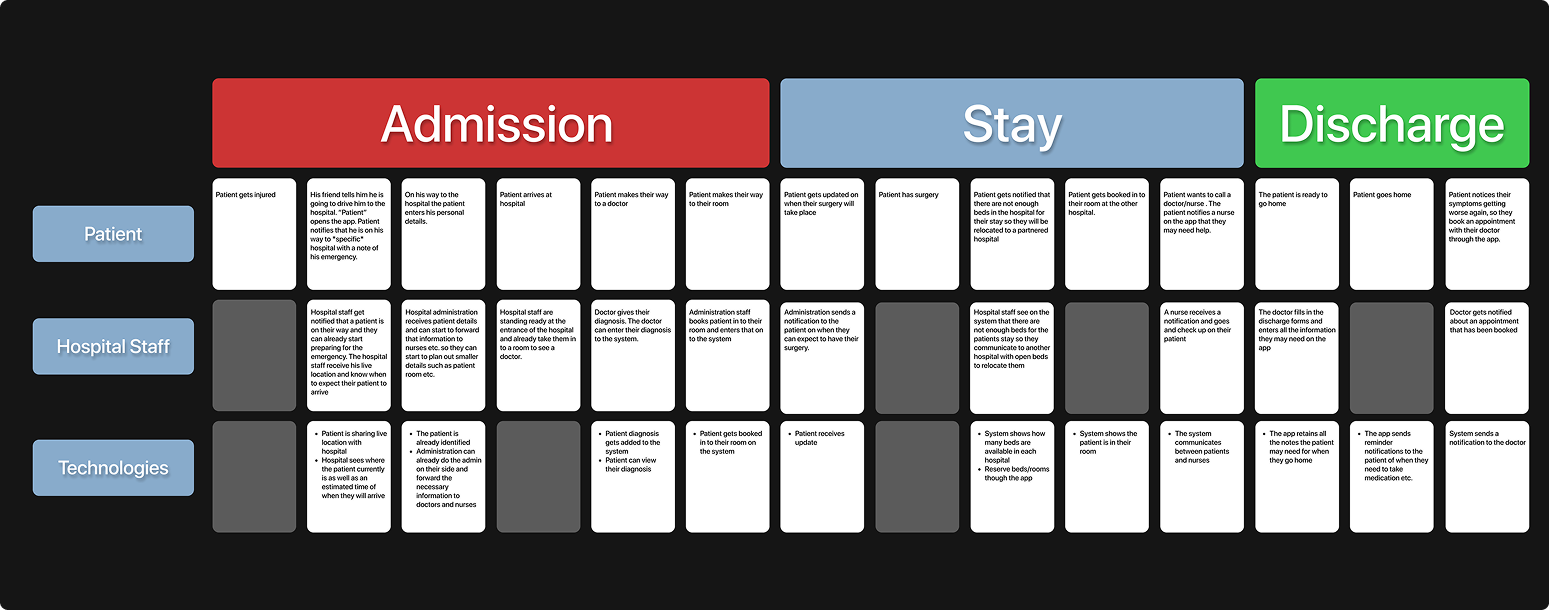
Future Blueprint
After identifying the key problems in the hospital patient journey, I
began planning how the HealthLink app would function. I started by
creating a future-state blueprint, which gave me a clear vision for
developing the user storyboard.
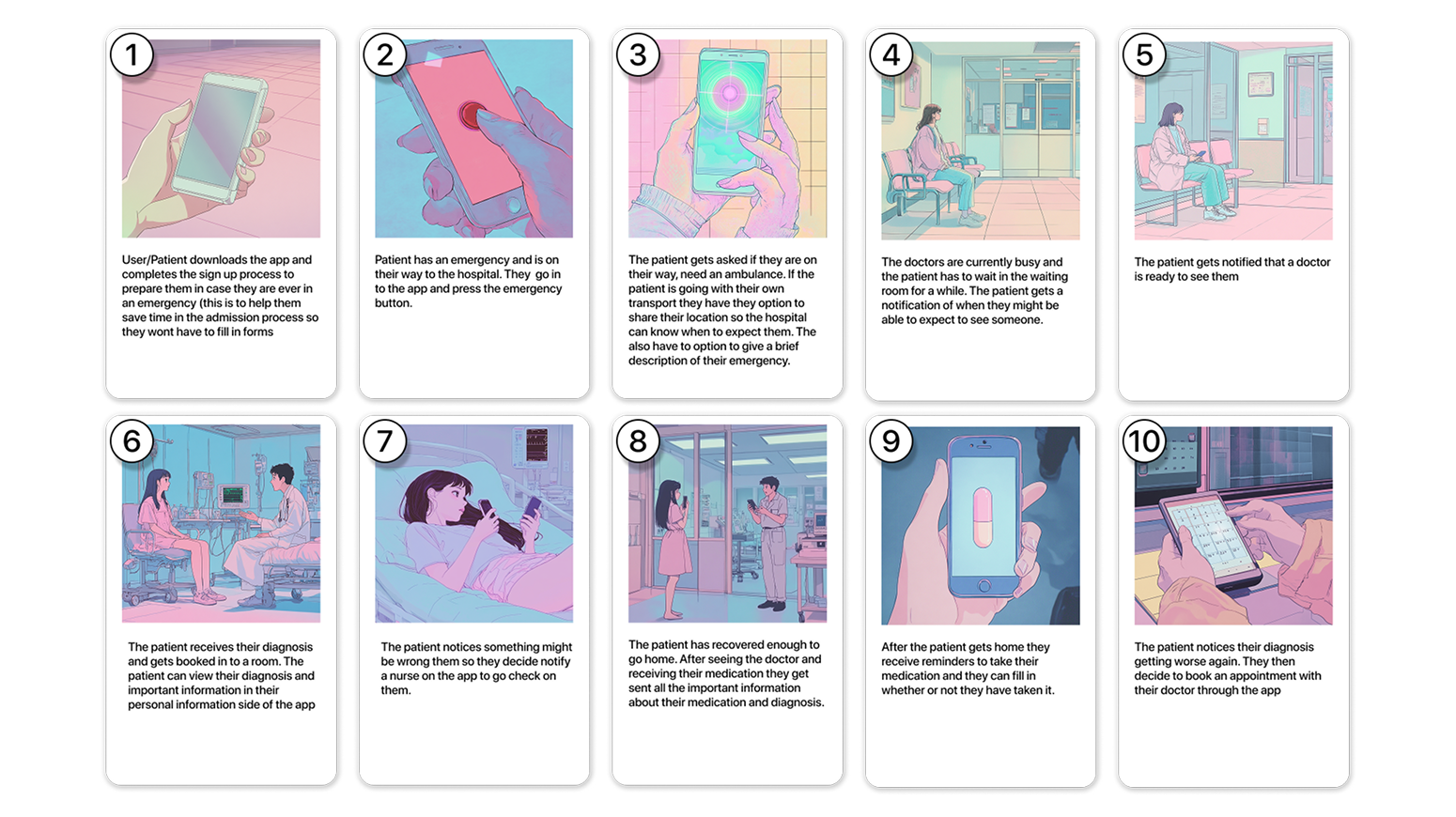
User Storyboard
A comprehensive visual storyboard illustrating the complete patient
journey through the HealthLink app, from initial app download and
emergency situations to diagnosis, treatment, and follow-up care. Each
numbered step shows key interactions and touchpoints that optimize the
hospital experience.